

Toyota has rekindled one of the fiercest rivalries in the off-road SUV market. The newly redesigned Land Cruiser and the sixth-generation 4Runner now sit directly in the company’s lineup, forcing shoppers to make a critical decision: do you want aggressive, modifiable trail capability or refined, luxury-laden wilderness touring? Understanding what separates these two vehicles and their price difference is essential for anyone considering a premium off-road SUV.
Two Different Philosophies, One Brand
The 4Runner arrives as the accessible volume leader, designed for a younger demographic that craves aggressive styling, extensive aftermarket potential, and raw off-road utility. It delivers truck-like capability wrapped in an enclosed SUV package, blending Tacoma-like performance with everyday practicality. The sales numbers back this positioning: the 4Runner moved 98,805 units in 2025 and surged another 33,244 units in the first quarter of 2026, a staggering 294 percent jump year-over-year.
The Land Cruiser, by contrast, targets a mature, affluent buyer seeking heritage, immediate refinement, and maximum capability right from the factory. Rather than the bloated luxury barge of generations past, this new iteration presents itself as a leaner, retro-styled premium adventure machine. While Land Cruiser sales lag behind the 4Runner’s explosive volume (43,946 units in 2025, 8,083 in Q1 2026), they represent a highly profitable niche segment.
Engine Options and Power Delivery
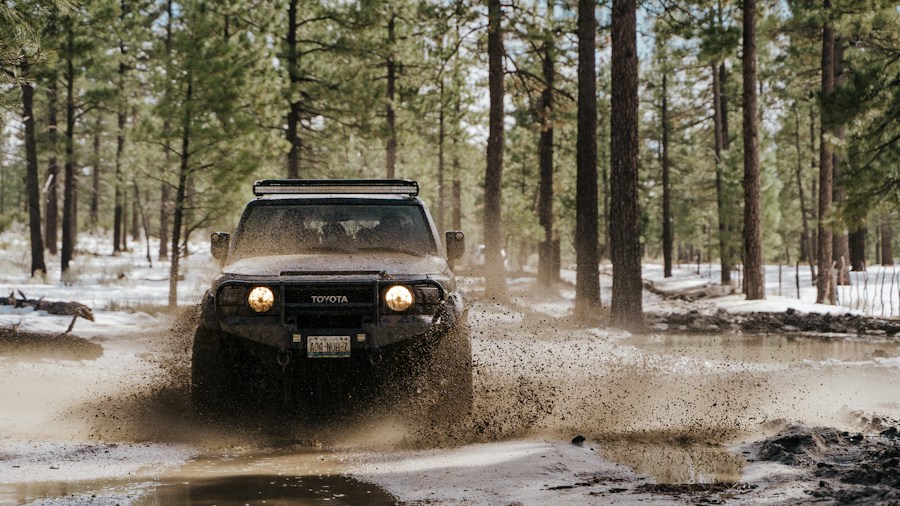
The powertrain comparison reveals how differently Toyota equipped each vehicle. The 4Runner offers genuine choice: buyers can select a standard 2.4-liter turbocharged i-FORCE four-cylinder producing 278 horsepower and 317 lb-feet of torque, or step up to the i-FORCE MAX hybrid system pairing that turbo engine with a 48-horsepower electric motor for 326 horsepower and 465 lb-feet of torque. Both engines connect to an eight-speed automatic transmission.
The Land Cruiser takes a singular approach, available exclusively with the i-FORCE MAX hybrid powertrain across its entire lineup. Every Land Cruiser delivers 326 horsepower and 465 lb-feet of torque as standard equipment, with that power routed through the same eight-speed automatic but directed to a standard full-time four-wheel-drive system. This strategy reinforces the Land Cruiser’s premium positioning: no base engine option means buyers always receive top-tier performance and capability.
Off-Road Engineering and Standard Features
Both vehicles ride on Toyota’s TNGA-F global truck platform with high-strength boxed steel-ladder frames, but their execution diverges significantly. The 4Runner operates as a scalable platform: base models use a traditional part-time four-wheel-drive system, while TRD Pro and Trailhunter trims unlock electronically locking rear differentials, a Stabilizer Bar Disconnect Mechanism for wheel articulation, and 33-inch all-terrain tires. The aggressive 4Runner geometry delivers a 33-degree approach angle on premium trims.
The Land Cruiser ensures extreme capability across its entire two-model lineup as standard. Every Land Cruiser includes full-time four-wheel-drive, a two-speed transfer case, and locking center and rear differentials as base equipment. It also features the Stabilizer Disconnect Mechanism and a standard five-speed Crawl Control system, essentially functioning as low-speed off-road cruise control. The geometry is slightly more conservative at a 31-degree approach angle, but it compensates with refined ride quality and predictable traction. The 4Runner demands active driver engagement and thrives on mechanical feedback, while the Land Cruiser delivers an insulated, protected cabin feel. Regarding towing, the Land Cruiser maintains a standard 6,000-pound capacity across all trims, while the 4Runner matches this with standard i-FORCE models but drops to 5,800 pounds on hybrid versions.
Interior Design Philosophy
The interior cabins showcase the most tangible expression of each vehicle’s purpose. The 4Runner’s cabin prioritizes active lifestyles with modernized, easily washable materials and chunky, tactile controls operable while wearing heavy work gloves. It offers an available third-row seating option on non-hybrid models for seven-passenger capacity, a power rear window, and a removable JBL Bluetooth speaker built into the dash. The aggressive seating posture and high dashboard retain that classic truck feel.
The Land Cruiser’s interior forgoes utilitarian grit for insulated luxury and retro-modern minimalism. Designed exclusively as a five-seater, it maximizes comfort and cargo space through premium soft-touch materials, extensive acoustic glass for superior sound deadening, and standard high-end technology including a massive 12.3-inch multimedia monitor. An available refrigerated console cool box and standard 2400-watt inverter add practical luxury, while the acoustic insulation makes the cabin feel like an executive lounge built for the wilderness.
Making Your Choice
The decision ultimately hinges on how you define off-roading and what you’re willing to spend. If you view four-wheeling as a high-adrenaline, tactile sport and want a vehicle you can modify extensively, the 4Runner represents the ultimate tool. Toyota’s hybrid technology continues to improve across its lineup, making the 4Runner’s hybrid option more appealing than ever.
Conversely, if your off-road adventures involve elegant overland touring and you demand maximum standard capability without wrenching, the Land Cruiser stands as the superior machine. You’ll pay substantially more for the hybrid powertrain, standard full-time four-wheel-drive, and plush interior, but you drive off the lot ready to cross the country with undoubted ease. Choose the 4Runner for aggressive rock-crawling potential; choose the Land Cruiser for refined wilderness exploration without compromise.










Write Your Review
No reviews yet. Be the first to share your experience!